Old Loyalties
Why we repeat our parents' relationship (and how to stop)
By M. R. Alder · October 31, 2026 · 10 min read
 Lived-experience review by Krasimira Trifonova
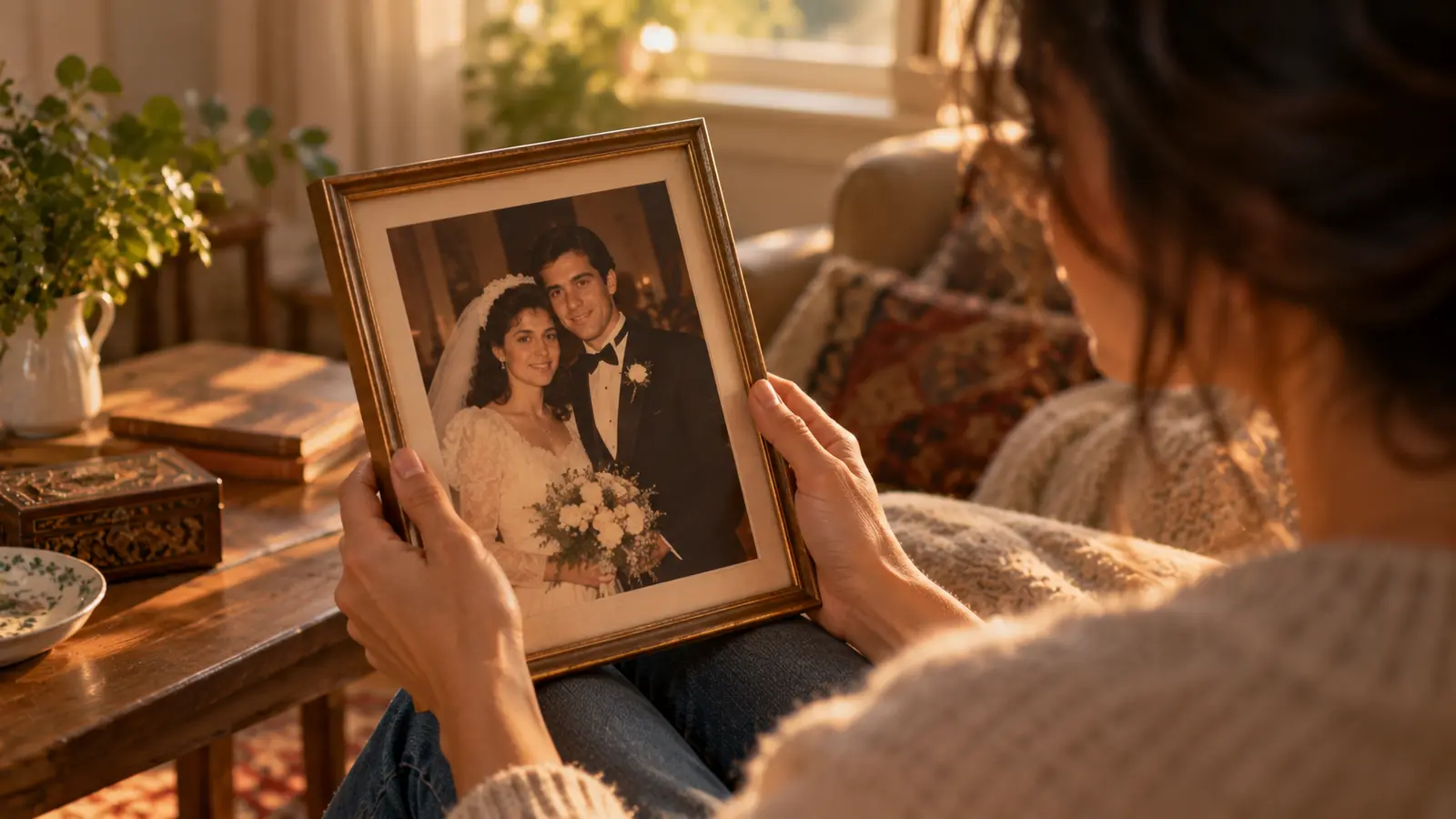
You promised yourself you'd never have a marriage like theirs.
You watched your mother wait for your father to come home. Or you watched them fight at the dinner table. Or you watched them live in polite silence, two strangers sharing a house. You swore your love life would be different.
And then, one day — maybe in the middle of an argument, maybe in a quiet moment of loneliness — you heard yourself say something your mother used to say. Or you realized the man next to you was more like your father than you'd ever admitted.
How did I end up here?
If this feels familiar, you're far from alone. Many women find themselves repeating their parents' relationship in some form, despite their best intentions. This article explores why it happens, how to recognize it, and how to create something different.
You learned love by watching
Long before you had your first crush, you were learning about love. Not from books or movies, but from the relationship right in front of you: your parents'.
Psychologist Albert Bandura's work on social learning showed that children learn a great deal simply by observing the adults around them. You absorbed how your parents spoke to each other, how they handled conflict, how they showed (or didn't show) affection, who held the power, who gave in, who left the room.
These observations became your first map of love. Not a conscious one — you probably couldn't describe it in words — but a deep, felt sense of this is what couples do.
Why familiar feels like chemistry
One of the most powerful reasons we repeat patterns is that familiar feels good — or at least, it feels right.
Social psychologist Robert Zajonc described the mere exposure effect: people tend to develop a preference for things simply because they're familiar. This applies to faces, music, places — and, many psychologists believe, to emotional patterns in relationships.
If you grew up in a home where love came with tension, unpredictability or distance, a partner who brings those same qualities may feel like chemistry. A calm, consistent partner may feel unfamiliar — and unfamiliar can easily be mistaken for "no spark." (See why healthy love feels boring.)
The pull to finish unfinished business
Another reason is less about familiarity and more about unfinished business.
Sigmund Freud used the term repetition compulsion to describe the tendency to repeat painful experiences. Many modern therapists see it less as a drive toward pain and more as an attempt at mastery: an unconscious hope that this time, it will turn out differently.
Couples therapist Harville Hendrix, author of Getting the Love You Want, built his Imago approach around a similar idea. He proposed that we're often drawn to partners who resemble our caregivers in both positive and negative ways, because, at some level, we're trying to heal old wounds. If your father was distant, you may be drawn to a distant man — and long to finally win his closeness.
This can feel like destiny or deep connection. Sometimes it's an old wound looking for a second chance.
Loyalty: the hidden reason
There's a third reason, often overlooked: loyalty.
Family therapist Ivan Boszormenyi-Nagy described how children form invisible loyalties to their families — unspoken commitments that can lead them to repeat their parents' patterns, even painful ones. Having a happier relationship than your mother can feel, at some deep level, like abandoning her. Choosing a different kind of man than your father can feel like rejecting him.
Family systems theorist Murray Bowen described how patterns are passed down through generations through what he called multigenerational transmission. Anxiety, roles and ways of relating can move from grandparents to parents to children, often without anyone noticing.
These loyalties aren't conscious decisions. They're a form of belonging. (Read more in invisible loyalty: when being happy feels like betrayal.)
What research shows
Research on intergenerational patterns in relationships suggests that the family you grew up in has real, measurable effects — and that those effects are tendencies, not destinies.
Sociologist Paul Amato and colleagues have studied the intergenerational transmission of divorce for decades. Their research has found that adult children of divorced parents are, on average, more likely to divorce themselves. Interestingly, research by Amato and Danelle DeBoer (2001) suggested that part of this effect may be about commitment — children who see their parents' marriage end may come to see marriage as less permanent — rather than only about conflict skills.
Other studies have found links between conflict in the family of origin and conflict in adult relationships. But across this research, one theme is consistent: many people break the pattern. Awareness, supportive relationships and new experiences make a difference.
The many ways we repeat
Repeating your parents' relationship doesn't always look like marrying a carbon copy of your father. It can take many forms:
Choosing a similar partner
The most obvious form: a partner whose temperament, habits or emotional style echoes one of your parents. Distant like Dad. Critical like Mom. Charming and unreliable like Dad.
Playing a parent's role
Sometimes you're not choosing your parent — you're becoming one. You find yourself acting like your mother: the martyr, the peacekeeper, the one who waits. Or like your father: the one who withdraws, controls or criticizes.
Recreating the same dynamic
Even with a very different partner, the relationship may develop the same shape: one pursues and one withdraws, one over-functions and one under-functions, one gives and one takes.
Repeating the same arguments
Many couples find themselves having the same fight their parents had — about money, family, time, respect — sometimes almost word for word.
Doing the exact opposite
Some women, determined not to repeat their parents' relationship, swing to the opposite extreme. If their parents fought, they avoid all conflict. If their mother was dependent, they refuse to rely on anyone. This can feel like freedom, but it's still being shaped by the past. The pattern is in charge either way.
Signs you may be repeating your parents' relationship
- You notice yourself saying or doing things your mother or father did.
- Your partner reminds you of a parent in an important way.
- Your arguments feel strangely familiar.
- You feel the same emotions in your relationship that you felt watching your parents: anxiety, loneliness, tension, resignation.
- You stay in situations your mother stayed in, or leave the way your father left.
- You feel guilty when your relationship is better than your parents'.
- Your choices are mostly about not being like your parents, rather than about what you want.
A composite story
The following is an illustrative composite, not a real client.
Lauren is 40. Her parents stayed married for thirty-five years, but it was a marriage of distance. Her father worked late and spent weekends in his garage. Her mother filled the silence with activity — cooking, cleaning, organizing everyone's life. They rarely fought. They rarely laughed together, either.
Lauren married a man who was kind but reserved. Over the years, she found herself doing everything: planning, organizing, managing the household and the social calendar. He withdrew into work and his phone. One evening, she caught herself wiping down an already clean counter while her husband watched TV in another room — and realized she was living her mother's life.
The realization was painful. But it was also the beginning of change. Lauren began talking with her husband about what she'd noticed. They started small: one evening a week with no phones, one honest conversation about how each of them felt. Her husband admitted he'd watched his own parents live the same way. Together, they began to build something neither of them had seen growing up.
How to stop repeating the pattern
1. Study your parents' relationship
Write about your parents' relationship as honestly as you can:
- How did they show affection?
- How did they handle conflict?
- Who held the power? Who gave in?
- What did each of them seem to need from the other?
- How did their relationship make you feel as a child?
Then, if you can, learn about their parents' relationships too. Patterns often become clearer across three generations.
2. Name the pattern in your own life
Look for parallels in your relationships — not to judge yourself, but to see clearly. You might write: "My mother waited for my father. I wait for men to choose me." Naming the pattern takes away some of its power.
3. Notice the pull of the familiar
When you feel strongly drawn to someone, get curious: "Does this person remind me of a parent? Does this dynamic feel like home?" The strength of an attraction isn't always a sign of compatibility. Sometimes it's a sign of familiarity. (See 5 signs your father shaped who you date.)
4. Change your part in the dance
Relationships are systems. If one person changes their part, the whole dance shifts. You can't control your partner, but you can change your responses: speaking up instead of keeping the peace, staying instead of withdrawing, asking directly instead of hinting.
5. Learn the skills your parents didn't have
Many parents never learned how to handle conflict well, express needs clearly or repair after arguments. These are learnable skills. Relationship researcher John Gottman, for example, has identified patterns that predict relationship breakdown — such as criticism, contempt, defensiveness and stonewalling — and the healthier alternatives, like gentle start-ups and repair attempts.
6. Give yourself permission to have more
If you notice guilt about having a happier relationship than your parents, try a sentence like:
"Mom, Dad — I honor your story. I'm choosing to live mine."
Having a better relationship isn't a betrayal of your parents. Many women find it becomes, over time, a way of completing something their parents couldn't.
7. Don't just rebel — choose
If your choices are mostly about avoiding your parents' mistakes, ask yourself: "What do I actually want?" Freedom isn't the opposite of your parents' relationship. It's the ability to choose what fits you.
8. Get support
Coaching can help you see your patterns clearly and practice new ways of relating. Couples coaching or therapy can help both partners understand the patterns they brought from their families. If your parents' relationship involved violence or abuse, a licensed therapist can offer deeper support.
A three-generation exercise
Patterns often become clearer when you look further back. Family therapists use a tool called a genogram — a family map that shows relationships across several generations. You don't need special training to make a simple version.
Take a large sheet of paper and draw:
- Your grandparents on both sides, and a few words about their relationships. Long marriage, little affection. Divorced. Grandfather drank. Grandmother ran everything.
- Your parents, and a few words about their relationship. Fought often. Distant. Mother waited, father left.
- Yourself, and a few words about your relationships so far.
Then look for repeating themes:
- Who held the power in each generation?
- How was conflict handled?
- Were there patterns of leaving, waiting, rescuing, controlling, staying silent?
- What was never talked about?
- Which women seemed to sacrifice the most?
Many women are surprised to see that a pattern they thought was "theirs" has been passed down through several generations. That realization can bring compassion — for your parents, your grandparents and yourself. It can also bring a sense of purpose: "This pattern can stop with me."
When both of you are repeating
Often, both partners are repeating something. Two people bring two family histories into one relationship, and the patterns can fit together like puzzle pieces: her pursuing mother and his withdrawing father, her caretaking role and his need to be taken care of.
Talking openly about your families can be one of the most powerful things you do as a couple:
- What did each of us learn about love growing up?
- What patterns from our families do we see in us?
- What do we want to keep? What do we want to do differently?
When both partners see the patterns, they stop being enemies and become a team.
A short self-check
- What did my parents' relationship teach me about love?
- What do I see of my mother in me? Of my father?
- What pattern from my family do I most want to break?
- Where am I doing the opposite — and is it really what I want?
- What would a relationship that's truly mine look like?
You can honor where you came from and choose where you go
Repeating your parents' relationship isn't a failure. It's what happens when we learn love from the people who raised us. The good news is that patterns that were learned can be understood — and understood patterns can be changed.
You don't have to reject your parents to choose differently. You can honor their story and still write your own.
Curious which root shapes your love life most? Take the free love root quiz to see your strongest pattern and a first step. And if you'd like to explore your family's patterns in a calm, private conversation, Helen, our AI coach, is available whenever you're ready.
From Roots to Love offers coaching and education, not therapy. If your family history includes violence, abuse or addiction, please consider support from a licensed mental health professional. If a relationship involves control, threats or violence, contact the National Domestic Violence Hotline at 1-800-799-7233 or see our crisis resources.
Frequently asked questions
Why do we repeat our parents' relationship patterns?
We learn about love by watching our parents. Their relationship becomes our first model of what love looks, sounds and feels like. Familiarity can feel like chemistry, unresolved childhood longings can draw us to similar partners, and unconscious family loyalties can make doing it differently feel like betrayal.
Is it true that you marry someone like your father?
Not always, but many people are drawn to partners who feel emotionally familiar — sometimes like a parent, sometimes like the parents' relationship as a whole. The similarity is often in how the relationship feels rather than in looks or personality.
Are children of divorce more likely to divorce?
Research, including work by sociologist Paul Amato, has found that adult children of divorced parents are on average somewhat more likely to divorce themselves. But this is a statistical tendency, not a destiny, and many children of divorce build lasting marriages.
How do I stop repeating my parents' mistakes in relationships?
Start by looking honestly at your parents' relationship and naming the patterns. Then notice where those patterns appear in your own life, become curious about the pull toward familiar partners, practice different responses in conflict, and allow yourself to have a different relationship without guilt.
What if I'm doing the opposite of my parents?
Doing the exact opposite can still be a way of being shaped by them. If your choices are mostly about not being like your parents, rather than about what you actually want, the pattern is still in charge. The goal is freedom of choice, not rebellion.