Old Loyalties
The mother wound: how your relationship with your mother shapes love
By M. R. Alder · October 19, 2026 · 11 min read
 Lived-experience review by Krasimira Trifonova
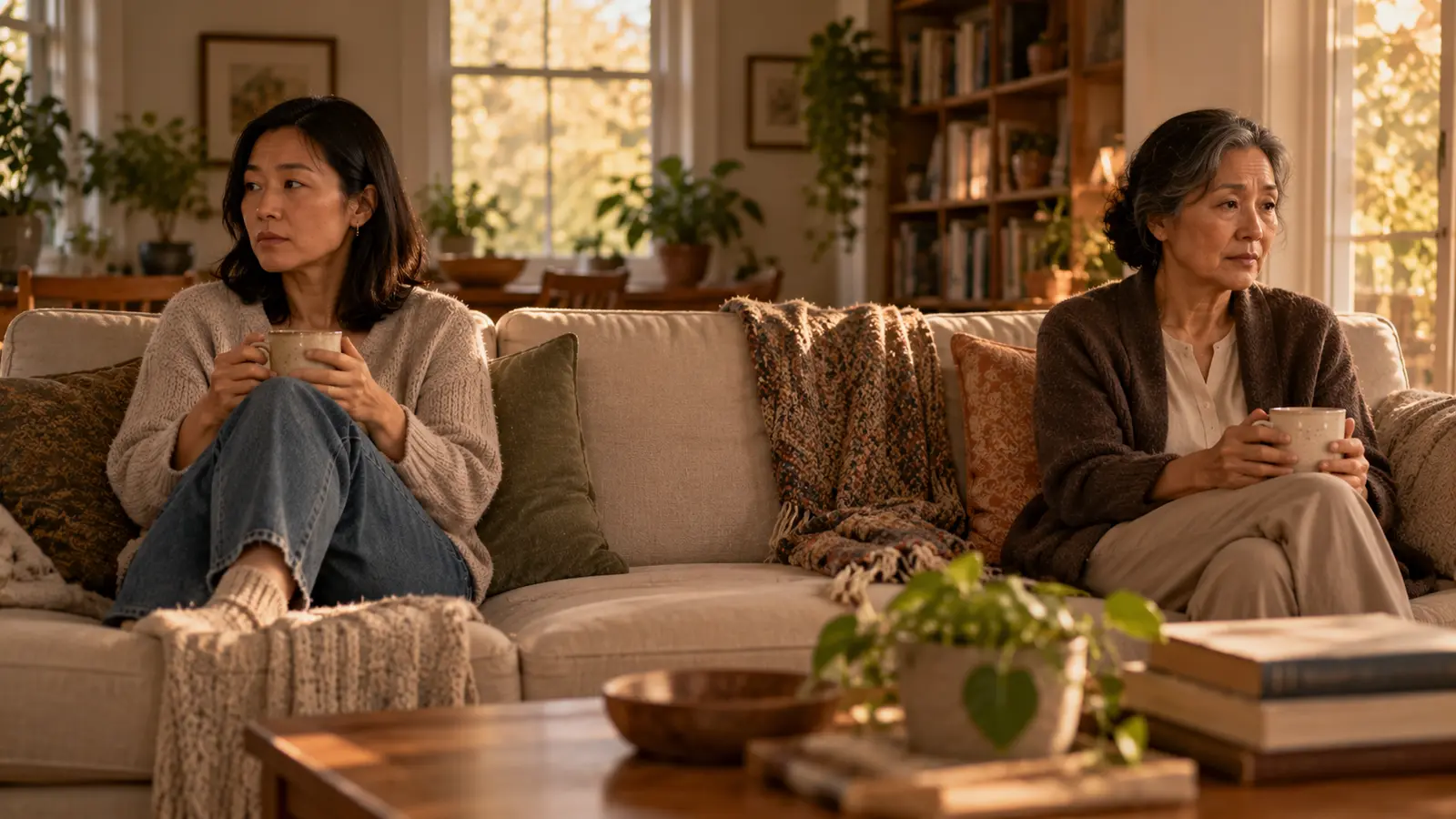
There's a kind of conversation many women have with their mothers that leaves them feeling, afterward, about twelve years old.
Maybe it's a comment about your weight. A question about why you're still single. A sigh when you mention your plans. Or maybe it's not anything she says at all — it's the way you instinctively shrink, explain, defend or perform around her, even as a grown woman with a life of your own.
If you've ever wondered why your relationship with your mother still has so much power over you — and why it seems to show up in your love life too — you may relate to what many people call the mother wound.
This article explores what the mother wound is, how it shows up in adult daughters, how it affects romantic relationships, the loyalty that often keeps it in place, and how to move forward without having to reject where you came from.
What is the mother wound?
The mother wound is not a clinical diagnosis. It's a popular term — used by many writers, including Bethany Webster in her book Discovering the Inner Mother — for the lasting effects of a painful, missing or complicated relationship with one's mother.
It doesn't necessarily mean your mother was cruel or neglectful. Many mothers who loved their daughters deeply still couldn't give them what they needed, because of their own history, depression, anxiety, exhaustion, poverty, an unhappy marriage, or simply not knowing how.
At its core, the mother wound is often about one or more of these experiences:
- Not feeling seen — your feelings, preferences and inner world weren't noticed or valued.
- Conditional love — affection seemed to depend on being good, quiet, pretty, successful or helpful.
- Criticism — you grew up with a steady stream of correction, comparison or disappointment.
- Control or enmeshment — there wasn't much room for you to be separate, private or different.
- Emotional absence — your mother was physically present but emotionally unavailable.
- Role reversal — you took care of your mother's emotions instead of the other way around.
Some women experienced a mother who was too far (distant, absent, cold). Others experienced a mother who was too close (intrusive, controlling, emotionally dependent). Many experienced both at different times.
Why the mother relationship matters so much
For most children, the mother is the first and most important source of comfort, safety and mirroring. Pediatrician and psychoanalyst Donald Winnicott described the importance of the "good-enough mother" — not a perfect mother, but one who is attuned enough to her child's needs that the child develops a basic sense of being real, worthy and safe.
Research by developmental psychologist Edward Tronick — famous for the "Still Face" experiment, in which a mother stops responding to her baby for a short time — showed how quickly infants become distressed when emotional connection is withdrawn, and how important repair is. Tronick's work also found that ordinary mother–infant interactions are frequently out of sync; what matters is that mismatches are repaired again and again.
When repair happens reliably, a child learns: "When things go wrong, we come back together." When it doesn't, she may learn: "I'm on my own with my feelings" or "I have to fix things to stay connected."
These early lessons often become the background music of adult relationships.
Signs you may carry a mother wound
You don't need to relate to all of these. Many women recognize several:
In how you see yourself
- A harsh inner critic that sounds a lot like your mother — or like the opposite of her.
- Difficulty trusting your own feelings, choices or perceptions.
- A sense that you're too much — or not enough.
- Perfectionism: if you can be flawless, maybe you'll finally be acceptable.
- Body image struggles connected to comments you heard growing up.
In your relationship with your mother
- Feeling responsible for her happiness.
- Guilt when you set boundaries, say no or make choices she disapproves of.
- Feeling like a child again when you're around her.
- Still seeking her approval — or rejecting everything she stands for.
- Anxiety before phone calls or visits.
In your relationships with others
- People-pleasing and difficulty saying no.
- Over-giving and difficulty receiving.
- Comparing yourself to other women, or feeling competitive with them.
- Distrust of female friendships, or an intense longing for a "mother figure."
- Difficulty asking for help.
How the mother wound shows up in love
The father relationship often gets the most attention when it comes to romance. But the mother relationship shapes love too, often in less obvious ways.
Fear of being controlled
If your mother was controlling or intrusive, you might find yourself bristling at any sign of a partner wanting to influence your choices — even reasonable ones. You may guard your independence fiercely and feel suffocated by closeness. (See avoidant attachment in women.)
Difficulty knowing what you need
If your feelings weren't mirrored as a child, it can be hard to identify them as an adult. You might say "I'm fine" automatically, or only realize you were hurt days later.
Repeating her role
Many daughters find themselves playing their mother's role in relationships — the martyr, the caretaker, the critic, the one who holds everything together — even if they swore they never would.
Repeating her relationship
Sometimes daughters end up in relationships that look strikingly like their mother's: with a similar kind of man, similar arguments, similar disappointments. This is often not a coincidence. (See why we repeat our parents' relationship.)
Choosing partners who need mothering
Daughters who took care of their mothers' emotions often find themselves drawn to partners who need care, rescue or fixing. Being needed can feel like being loved. (See the parentified daughter.)
Choosing critical partners
If criticism was the language of love at home, a critical partner can feel strangely familiar — and a partner who simply appreciates you can feel suspicious.
Guilt about being happy
Perhaps the most hidden effect: feeling guilty about having a better relationship, a freer life or more joy than your mother had. This is one of the clearest signs of an invisible loyalty.
The loyalty that keeps the wound in place
Family therapist Ivan Boszormenyi-Nagy, who wrote Invisible Loyalties with Geraldine Spark, described how children develop deep, often unconscious loyalties to their parents. These loyalties aren't bad — they're a form of love and belonging. But they can lead daughters to sacrifice their own happiness without realizing it.
With mothers, invisible loyalty can sound like:
- "If I'm happy in love, I'm leaving her alone in her unhappiness."
- "If I have a better life than she did, I'm saying her life wasn't good enough."
- "If I set boundaries, I'm abandoning her."
- "If I'm different from her, I'm rejecting her."
Family systems theorist Murray Bowen described the goal of healthy family relationships as differentiation of self: being able to stay emotionally connected to your family while still thinking, feeling and choosing for yourself. A well-differentiated daughter can love her mother and live her own life — without feeling she has to choose. (Read more in invisible loyalty: when being happy feels like betrayal.)
A composite story
The following is an illustrative composite, not a real client.
Priya is 36. Her mother was devoted, sacrificing and often anxious. She gave up her own career to raise the children, and reminded Priya of it frequently. She commented on Priya's clothes, her friends, her weight and, later, her boyfriends. Love and criticism always arrived together.
As an adult, Priya was successful and well-liked, but she found romantic relationships exhausting. She either dated men she had to take care of or men who criticized her in ways that felt oddly comfortable. With kind, easygoing partners, she found herself irritated and restless.
The turning point came when her partner at the time, during a calm conversation, said, "You seem to brace yourself whenever I say anything about you, even when it's a compliment." Priya realized she was waiting for the criticism that always came after the praise at home.
Over the next year, Priya began to separate her mother's voice from her own. She noticed when her inner critic spoke in her mother's words and practiced answering it. She set small boundaries — ending calls when comments about her weight began. It was painful. Her mother was hurt at first. But slowly, their relationship became more honest, and Priya began to feel at ease with a man who simply liked her as she was.
How to heal the mother wound
1. Acknowledge what was missing
Healing begins with naming what you didn't receive — without needing to make your mother a villain. "I didn't feel seen." "I felt I had to earn love." "I felt responsible for her feelings." Both things can be true: she loved you, and something important was missing.
2. Understand her story
Many women find it helpful to learn more about their mother's history: her childhood, her relationship with her own mother, the pressures she faced. This isn't about excusing harm. It's about seeing her as a whole, complex human being, and understanding that the wound often runs through several generations.
3. Grieve the mother you needed
You may need to grieve the mother you wished you had — the one who would have listened, protected you, delighted in you. This grief can be intense, and it's an important part of letting go of the hope that she'll suddenly become someone else.
4. Separate her voice from yours
Notice your inner critic. Whose voice is it? When you hear, "You're too much," "Who do you think you are?" or "You'll never be good enough," ask: "Is this my belief, or one I inherited?" Then practice answering with the voice of the mother you needed — what Bethany Webster and others call inner mothering.
5. Set boundaries with love
Boundaries are not punishments. They're ways of protecting a relationship so that it can continue. You might:
- Change the subject when certain topics come up.
- Limit the length or frequency of visits.
- Decline to share details of your love life.
- End a conversation when it becomes hurtful.
"I love you, and I'm not going to discuss my weight. Let's talk about something else."
Expect some pushback. Families often resist changes in long-standing roles. Stay kind and consistent. (See how to set boundaries without guilt.)
6. Release the role you played
If you were your mother's caretaker, confidant or peacekeeper, you can begin to step out of that role. Not by abandoning her, but by allowing her to carry what's hers. A sentence many women find helpful:
"I love you, and I'm not responsible for your happiness."
7. Give yourself permission to be happy
If you notice guilt about having a better life than your mother, try this reflection:
"Mom, you gave me life. I'll honor it by living it fully — including the parts you couldn't."
Many women find that their happiness becomes, over time, a way of honoring their mother rather than leaving her behind.
8. Choose relationships that offer what you missed
Look for partners and friends who see you, appreciate you and respect your separateness. Notice the discomfort that may come with being treated well — and stay with it. Over time, it can become familiar in a new way.
9. Get support
Coaching can help you understand your patterns and practice new ways of relating. If your relationship with your mother involved abuse, severe neglect, or a mother with serious mental health struggles, a licensed therapist can offer deeper support. In situations of ongoing harm, limiting or ending contact may be necessary — and that decision deserves support, not judgment.
When your mother is still part of your daily life
Many women heal the mother wound while still having a close, everyday relationship with their mothers — especially in cultures where family closeness is expected, or when a mother is aging or ill. A few principles help:
- You can love her and limit what you share.
- You can help her and protect your time and energy.
- You can listen to her advice and still make your own choices.
- You can accept her limitations without accepting harmful behavior.
Healing doesn't always change your mother. It changes how much her reactions decide your life.
When you become a mother
Many women find that the mother wound comes back into focus when they have children of their own. Holding a baby can stir up unexpected grief: "Did anyone ever hold me like this?" You may hear your mother's words coming out of your mouth, or feel a fierce determination to do everything differently.
Both reactions are normal. You don't have to be a perfect mother to break a pattern. Winnicott's idea of the "good-enough mother" applies to you too. What matters most, as Tronick's research suggests, isn't avoiding every mistake — it's noticing ruptures and repairing them. A mother who can say "I'm sorry I snapped. That wasn't about you" is giving her child something many women of earlier generations never received.
A short self-check
- What did I need most from my mother that I didn't receive?
- What role did I play in our family?
- Whose voice does my inner critic sound like?
- Where do I notice my mother's patterns in my relationships?
- What's one boundary I could set — kindly — this month?
You can honor your roots and still grow
Your relationship with your mother is part of your roots. It shaped you in ways both painful and precious. Healing doesn't mean cutting those roots off. It means growing in your own direction — with enough freedom to choose the love you actually want.
Curious which root shapes your love life most? Take the free love root quiz — many women with a mother wound recognize themselves in The Loyal Daughter or The Bridge. And if you'd like a calm, private space to explore your story, Helen, our AI coach, is available whenever you need it.
From Roots to Love offers coaching and education, not therapy. If your relationship with your mother involved abuse, neglect or ongoing harm, please consider support from a licensed mental health professional, or see our crisis resources.
Frequently asked questions
What is the mother wound?
The mother wound is a popular, non-clinical term for the lasting effects of a painful or unmet relationship with one's mother — for example, feeling unseen, criticized, controlled or emotionally unsupported. It is not a diagnosis, but many women find it a useful way to understand patterns in their self-worth and relationships.
What are signs of a mother wound?
Common signs include a harsh inner critic, difficulty trusting your own feelings and choices, people-pleasing, guilt when setting boundaries with your mother, feeling responsible for her emotions, competing with or comparing yourself to other women, and difficulty receiving care.
How does the mother wound affect romantic relationships?
It can show up as fear of being controlled or engulfed, difficulty asking for what you need, over-giving, choosing partners who are critical or needy, or repeating your mother's relationship patterns. It can also make it hard to trust your own judgment in love.
Can you heal the mother wound without cutting contact?
Yes. Many women heal while staying in contact with their mothers by understanding their history, grieving what was missing, setting clear boundaries and building their own sense of self. In some situations, especially where there is abuse, limiting or ending contact may be necessary for safety.
Is the mother wound the same as having a narcissistic mother?
No. A mother wound can come from many situations — a depressed, overwhelmed, anxious, absent or critical mother, or one who simply could not offer the kind of attunement a child needed. A mother with narcissistic traits is one possible source, but not the only one.